I also made a Youtube Video for anyone that prefers a video format:
Perhaps you’re an author who has the audio rights to your book, and you don’t have a lot of funds to turn it into an audio book. This article is for you, so read on! If you’re not an author, but you’re a consumer of books and audiobooks, and you want to learn how to have a robot read you a book for free, that’s not what this article is about, but you can probably have your tablet or your phone do that if you look under accessibility. Maybe you’re an author thinking of selling a robot voice version of your book. You should know that option is already available to readers. As I mentioned above they can just use the accessibility function on their phone or tablet. That means they’re probably not going to buy it from you. So, back to the original question: can you make an audiobook for free? There’s no such thing as a free lunch as they say. There are, however, a few options for those who don’t have the capacity to pay for an audiobook production outright, and want to find an alternative solution.
Can I just do it myself?
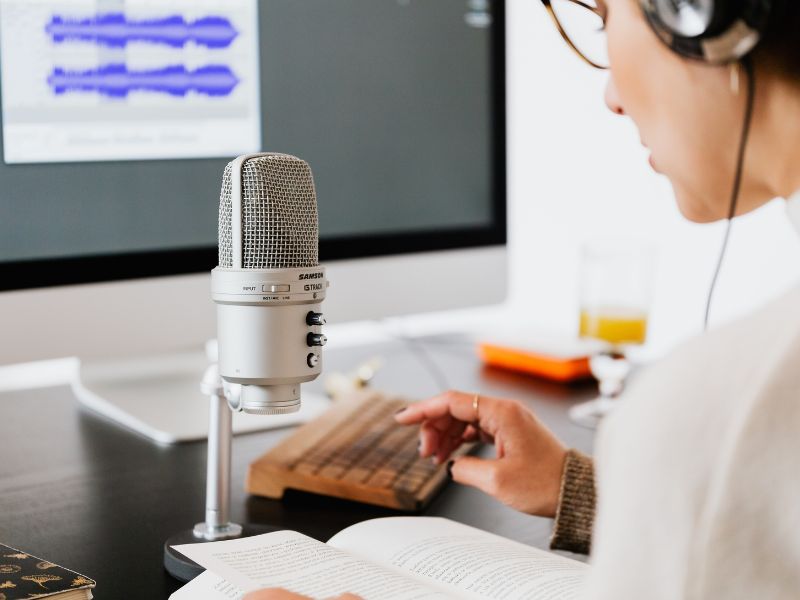
As an author, especially of the indie persuasion, you likely have a DIY mentality. So, you might be thinking, “I have a good voice. I can read. I can just narrate the audiobook myself.” Let’s not get into the acting skills required, but instead, we’ll assume that you’re also an actor and already have these skills. Recording your audiobook may be an option, but doing it yourself is not free. In fact, startup costs can be pretty high. If that scares you, go ahead and skip ahead to the section on “Royalty Share”. Otherwise, here’s what you will need:
– A decent condenser microphone and accessories -cables, and pop filter. (that will be at least $225)
– Boom arm for your microphone and a shock mount, which most microphones don’t come with. ($75 or so)
– Depending on the type of microphone, you’ll likely need an interface that’s around $150 or so.
– A good computer with a lot of storage (free if you already own one)
– A “DAW”, or “Digital Audio Workstation” aka recording software (Audacity isn’t great, but it’s free)
-A quiet space to record in. You don’t need to buy a soundproof booth. I paid about $10,000 including shipping for my prefab “Studiobricks” booth, which arrived at my apartment in a bunch of pieces. I would only recommend that kind of purchase to someone doing narration as a full time career. Most likely, you will be working with what you already have. If you live alone, that might be easy if you don’t have noisy neighbors and leaf blowers all day. If you have roommates, pets, or kids, you may need to record in the middle of the night. If you have a walk-in closet, that’s a great option as a booth because you already have clothing in there, which is going to absorb some of the reflections (echo-type noise). Audiobook listeners don’t want to hear reverb in an audiobook. They want to hear and understand every single word you say. With a walk-in closet and a lot of blankets and clothing, you might not have to spend any extra money. If you don’t have a walk-in closet, you can buy some moving blankets and some PVC pipes and build your own DIY booth for around $100. That won’t get rid of the noise, but it will reduce the reflections.
-Accessories for holding your tablet, assuming you have a tablet, or your phone if that’s all you have for reading your script on. Your computer screen will be tied up with the recording software. (around $15-$25)
Once you get your book recorded, you will need to hire someone to do the editing, mastering, and proofing. That usually runs about $100-$125 per finished hour in 2026. A “finished hour” is an hour of the actual audiobook (not including any bloopers that have been edited out). If your finished audiobook is 10 hours, you will have spent about $1250 on post-production engineering.
We’re not going to get into the time required to actually record the thing. That’s another can of worms. We’ll just assume that you have the time. Maybe you’re retired and this is something you can do in your leisure time. So, at the end of the project, when you add up all the expenses, a 10-hour audiobook can easily run you over $1500. That’s not free. Not even close. It might be worth the investment if you enjoy narrating and you plan on doing multiple books. If you are a Non-Fiction author, you do podcasting already, and you already have the equipment and the recording space, definitely look into that. For everyone else, I would suggest looking at one of these next options:
Royalty Share
You may have already heard about Royalty Share, especially if you have ever signed up with ACX, or the Audiobook Creation Exchange. They are owned by Audible, which is owned by Amazon. ACX has been a popular way for many indie authors to get their books in audio. One of ACX’s services is matchmaking. It pairs up indie authors and narrator/ producers. Sidenote: I’m saying “narrator/ producers” because they’re not just narrating the book. They are also responsible for the post-production, whether they do it themselves or outsource it. An ACX narrator/producer will deliver retail ready files. All you have to deliver is the manuscript and the cover art. The other service ACX offers is distribution, but they only distribute to Audible (Amazon) and iTunes. ACX is usually the first stop for indie authors who want to publish their first audiobook. It’s also used by self-motivated voice actors who want to narrate audiobooks. For the purpose of this article, I’m going to use the term “Rights holder” to refer to indie authors who use ACX, and “narrator” to refer to narrator/ producers.
The ACX platform is pretty easy to use from the author’s side, and it has a lot of flexibility. This is because once the narrator is cast, they will narrate the book, handle all of the post-production. and upload the files straight into the platform. One thing to note is that although the ACX is used for casting and distribution, you don’t have to use it for both, although many do. But if you only want to go to ACX to cast your narrator, or you want to go there just to distribute your files once you already have them ready, those options are available. If you wrote a book and you want to distribute it through ACX, you need to specify what kind of contract you want to do. The options are “Per Finished Hour” (“PFH”), “Royalty Share”, and “Royalty Share Plus” (formerly known as a “Hybrid” deal. PFH means that you pay for the audiobook narration and production outright. That’s not what you’re here for, so we’ll skip that one. With Royalty Share, you don’t pay anything until you get paid. What’s really nice is that ACX handles the royalty payments for you. They pay you and they also pay your narrator. Royalty Share Plus is a hybrid of the PFH and Royalty Share. We won’t go into details here, but I’ll just mention that Royalty Share Plus follows the same rules as Royalty Share, so the distribution restrictions on Royalty Share contracts are the same for Royalty Share Plus.
You may have concluded that a Royalty Share contract isn’t really free since you are actually splitting the profits with the narrator. But if you’re just dipping your toes in the water and you have no idea how well (or unwell} your audiobook is going to do, it might be worth trying out.
To use ACX, you need to be a resident of the United States, Canada, UK, or Ireland. Here is a full list of the ACX Requirements. There are additional requirements for authors that want to use the Royalty Share program. For instance, you must select exclusive distribution. That means you must post your audiobook exclusively on ACX and no other platforms- not even YouTube. You also cannot sell it from your own website. All of the proceeds that come from listeners or anyone purchasing your audiobook must come through Amazon, Audible, or iTunes. That’s because you’re sharing your profits with your narrator, so ACX needs to have the record of how many purchases are coming in so they can pay them. One thing to note is that you can only split payment with one other person (usually the narrator). If you have a project that is a dual or duet narration project, that can be more complicated. Since the narrator pay is going to just one account, you will need to find a narrator who is either married to their narration partner, or is willing to take a gamble and pay another narrator out of their own pocket.
If you have a series, and plan to eventually bundle the series, you must use the same narrator for every book. Again, it has to do with making sure the narrator you contract gets their pay from every sale.
ACX’s program is not the only royalty split program available, but it is the most common one for residents of the US, Canada, Ireland and the UK. It’s pretty easy to use, and you don’t need to already have connections with audiobook producers or publishers. If ACX isn’t an option for you, here’s a quick Youtube tip with some other options: Can You Do a Royalty Split Without doing an Exclusive ACX Contract?
One more thing I’m going to mention. Royalty Share does not have a contract for SAG-AFTRA narrators. If you want to work with a union narrator, you’ll either have to do a Per Finished Hour or a Royalty Share Plus contract with them. For Royalty Share Plus, the project must pay at least $100 per finished hour, plus half of the royalties.
Licensing Your Audio Rights
The next option is licensing your audio rights to a publisher. There are a few audiobook publishers that will assume some risk and license your audiobook if they think that it’s going to do well. The big ones right now in 2026 are Tantor Audio, Podium Entertainment, and a new imprint of Simon and Schuster called Simon Maverick. They all work with indie and hybrid authors who own their audio rights and want to license them out. These publishers actually have acquisition teams who will scout books that they think will do well in audio. It’s a good idea for you to have a website with your contact information available so they can find you. Some of them list their acquisitions contacts right on their websites, so you can self-submit your published titles. If you do end up working with them, they take care of everything from the casting to the audio engineering, and even some of the marketing. Now, if you’re thinking, “But I want to do the casting. I want to have a say in who the narrator is. Let them know that. That’s usually something that can be negotiated, and you might even suggest narrators that you have in mind.
Contracts can vary and they’re also not publicly available. So, I can’t talk about what percentage any publishers pay, or how much money you’re going to earn. Also, the actual number of sales you will make is always going to be unpredictable. But this is probably a great option for you if you have a higher budget book, including dual, duet, or multicast narration, and you have two or three narrators that are going to to be paid individually. The publishing house will take care of that. They’re not going to accept every book, of course. They’re going to choose the ones they think are going to make a profit, or at least have a chance of making a profit. Another bonus is that most publishers will distribute your audiobook “wide”, which means not just Audible or iTunes, but all of the retailers and libraries that do audiobooks.
Crowdfunding
Okay, what if you want to keep your rights? You want to keep your profits and the control. The last option I’m going to discuss is crowdfunding. Yes, you can crowdfund an audiobook! Is every audiobook crowdfunding campaign going to be successful? No. But there are things that you can do to have a better shot at making it successful. And there have been plenty of success stories. It does take a lot of work. It might be time that you would rather use for writing your next book, but as an indie author, you did sign up for the extras. That’s part of the gig. If you want to crowdfund your audio book, think of it as a fancy pre-order. Have everything in place to show to your potential crowdfunders. You will need your cover art, and you need to have your narrators contracted and ready to go. Maybe even have a short clip from the upcoming audiobook. Research the rules for the crowdfunding service that you use. Some of them don’t allow what they consider to be “erotic” content. That may include steamy Romance or Romantasy books. Also, if you don’t reach your crowdfunding goal, you won’t receive a dime. So don’t make your goal too high. Be a bit conservative, especially if it’s your first crowdfunding campaign and you’re still testing the waters.
I hope this gives you some ideas on how to get your audiobook published, if not for free, at least in a way that you can afford. I see far too many authors on social media mention that they looked into the cost of production, and decided it wouldn’t be in their book’s future to have an audio version, when in fact, there are ways to make it affordable.
Thanks for reading!
Rebecca H. Lee
If you would like to get answers to your questions on audiobook production, get info on wide audiobook distribution, or hear my audiobook narration demos, visit my website at becksvoice.com!
Or connect with me at:
https://www.linkedin.com/in/rebecca-h-lee-audiobook-narrator/
https://bsky.app/profile/beckcentric.bsky.social
https://www.youtube.com/@RebeccaHLee
https://www.instagram.com/beckcentric
https://www.facebook.com/beckcentric
Audiobooks I’ve narrated can be found on Audible, Chirp, Kobo, and wherever you get your audiobooks.